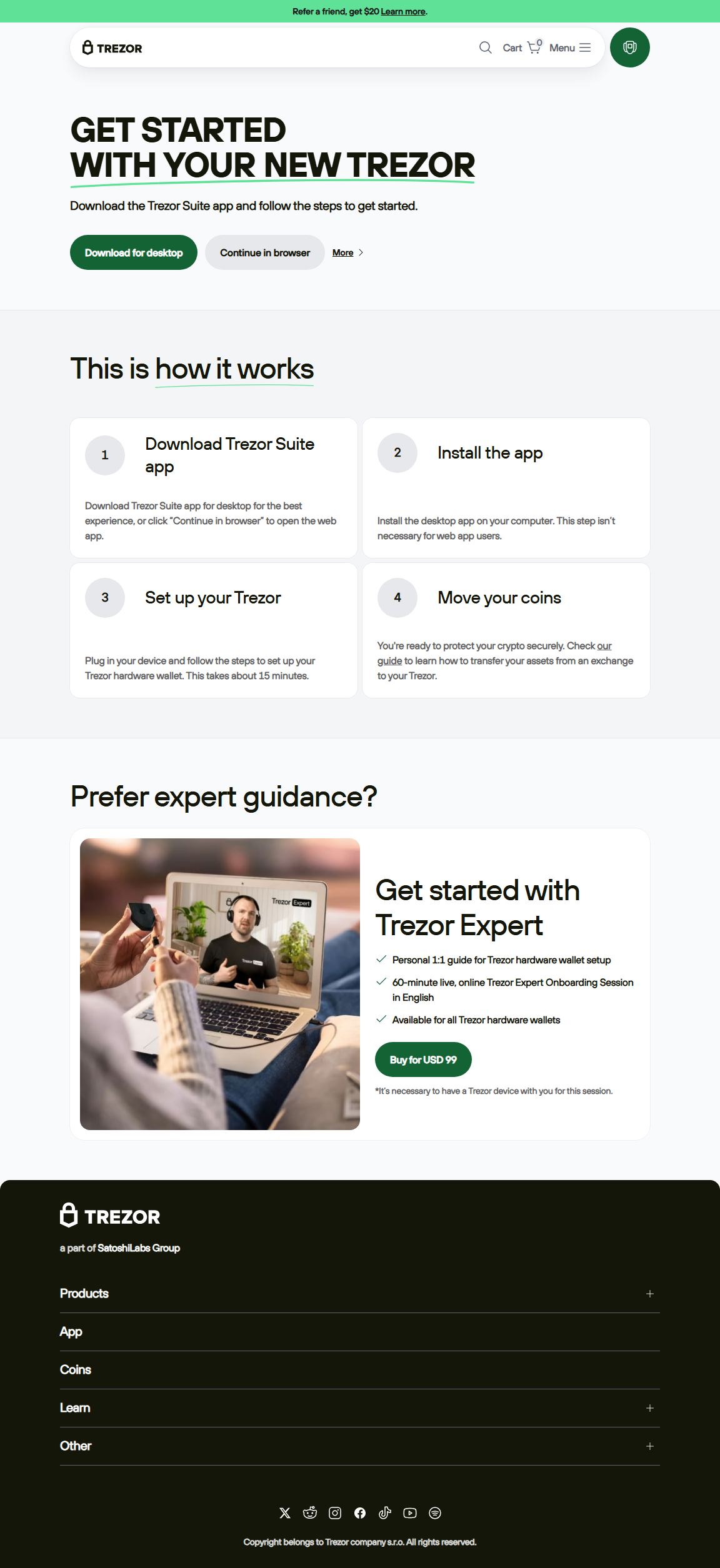
Trezor.io/Start — Your Gateway to Cold Storage Mastery
A complete guide to setting up, understanding, and mastering your Trezor hardware wallet through Trezor.io/start — from first connection to advanced crypto protection.
🔐 Why Hardware Wallets Like Trezor Are Essential
In crypto, there’s one golden rule: “Not your keys, not your coins.” While software wallets and exchanges offer convenience, they also expose your assets to cyber threats. Enter Trezor — a hardware wallet designed by SatoshiLabs that keeps your private keys offline, ensuring hackers can’t access your funds even if your computer is compromised.
Trezor.io/start is the official setup portal that helps users configure their Trezor safely. It’s where you download Trezor Suite, install firmware, and learn to manage crypto securely. No third-party downloads. No guesswork. Just verified safety from the source.
“With Trezor, your crypto security doesn’t depend on luck or a password — it depends on ownership.”
🧭 Step-by-Step Setup via Trezor.io/Start
Setting up your Trezor is straightforward, but every step matters. Here’s how to get started the right way:
1️⃣ Connect and Visit Trezor.io/start
Unbox your Trezor device and connect it using the included USB cable. Open your browser and navigate to trezor.io/start. This is your official launchpad — never trust any lookalike domains or “Trezor help” sites on social media.
Bookmark https://trezor.io/start now. If a site asks for your recovery seed, it’s a scam.
2️⃣ Install Trezor Suite
Next, download Trezor Suite — the official desktop app for managing your crypto. It replaces browser plugins with a secure, encrypted environment compatible with Windows, macOS, and Linux. The interface allows you to view your portfolio, send/receive assets, and customize settings.
When you first connect, the Suite will check your firmware. If an update is needed, install it before proceeding. Firmware updates contain critical security patches and new coin integrations.
3️⃣ Create a New Wallet
Select “Create new wallet.” The device will generate a random recovery seed — a 12-, 18-, or 24-word phrase. This is your backup. Write it down on paper (never digitally) and store it offline in multiple safe places.
Consider metal seed storage for durability against fire, water, or corrosion. Products like Cryptosteel or Billfodl work well with Trezor backups.
4️⃣ Set a PIN and Optional Passphrase
Choose a PIN to protect your device from unauthorized access. You can also enable a passphrase — an advanced feature that adds a secret “25th word” to your recovery seed, generating an entirely separate wallet only accessible with that phrase.
5️⃣ Add Coins and Begin Managing Assets
Once initialized, open Trezor Suite and click “Add Account.” You can manage Bitcoin, Ethereum, Litecoin, ERC-20 tokens, and more. The interface displays real-time balances and transaction histories, giving you full control of your digital assets — all while staying offline where it matters most.
💡 Trezor Model Comparison
| Feature | Trezor Model One | Trezor Model T |
|---|---|---|
| Display | 2-button OLED screen | Full-color touchscreen |
| Supported Assets | 1000+ coins | 1600+ coins |
| Security | PIN + seed protection | PIN + seed + Shamir backup |
| USB Interface | Micro-USB | USB-C |
The Model T is more future-proof and beginner-friendly thanks to its touchscreen interface and Shamir backup. The Model One, however, remains a cost-effective, highly secure option for Bitcoin-only or multi-asset users.
⚙️ Power Features You Should Know
- Shamir Backup (Model T): Split your recovery seed into multiple shares. You only need a subset to restore your wallet — perfect for disaster recovery.
- Hidden Wallets: Use custom passphrases to create invisible wallets that even a thief with your device can’t access.
- Tor Mode: Route your Suite connection through the Tor network for additional privacy.
- Custom Labeling: Use Trezor Labeling to tag accounts and transactions with metadata encrypted locally.
- DeFi Access: Connect your Trezor to MetaMask or other DeFi apps — your keys never leave the device.
📊 How Trezor Stacks Up vs Competitors
| Wallet | Security | Open Source | Ease of Use |
|---|---|---|---|
| Trezor | Offline storage, PIN, seed, optional passphrase | ✅ Yes | Beginner Friendly |
| Ledger | Offline storage with proprietary OS | ❌ No | Easy |
| MetaMask | Software wallet only | ✅ Yes | Very Easy |
Trezor remains the most transparent among top-tier wallets, with fully auditable open-source code — a trust cornerstone for crypto users.
❓ Frequently Asked Questions
Q1: What exactly is Trezor.io/start?
It’s Trezor’s official onboarding page, where users install Trezor Suite, verify device authenticity, and complete wallet setup securely.
Q2: Can Trezor be hacked?
It’s nearly impossible remotely. Physical attacks require advanced hardware access and still can’t reveal funds without the PIN or recovery seed.
Q3: Does Trezor support NFTs?
Yes, via integrations with third-party wallets like MetaMask — while keeping your private keys secure inside Trezor hardware.
Q4: What if I lose my device?
Use your recovery seed to restore funds on another Trezor. Never share or type your seed online, even for “support.”
Q5: Can I use Trezor on multiple computers?
Yes. As long as you connect via Trezor Suite or compatible apps, your wallet remains accessible — the private keys never leave the device.
🧩 Key Crypto Terms to Know
- Cold Storage: Offline storage of cryptocurrencies, immune to online hacks.
- Seed Phrase: A unique word combination to restore wallet access.
- Private Key: A cryptographic signature that grants ownership of funds.
- Firmware: Internal device software that powers the Trezor hardware.
- DeFi: Decentralized finance applications operating without intermediaries.
🏁 Final Thoughts: True Ownership Starts Here
Your crypto deserves more than a password and a web login — it deserves offline protection, verified code, and full ownership. By following Trezor.io/start, you’ve taken the most important step toward digital sovereignty.
Whether you’re securing your first Bitcoin or managing a diverse crypto portfolio, Trezor ensures that you hold the keys — literally. The moment your device is configured, your financial freedom exists entirely in your hands.
- Always start at Trezor.io/start.
- Write down your recovery seed offline.
- Keep firmware updated through Trezor Suite.
- Enable passphrase for extra protection.
- Never share your seed — ever.
When it comes to crypto safety, “cold” is the new gold — and Trezor keeps your fortune on ice, right where it belongs: under your control.